
"The Crystal Heart of Dust" - 12/08/25
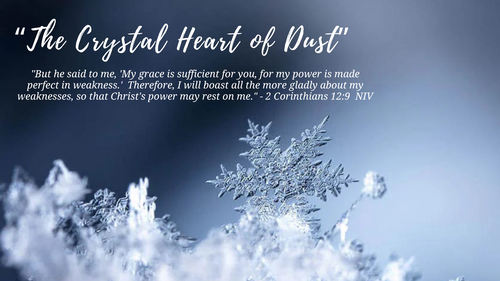
This week's devotion comes from a place of wonder and reflection. Yesterday, I preached on "The Gift of Imperfection," exploring how God weaves grace through the messy and broken parts of our lives, just as Matthew includes scandalous and surprising names in Jesus's genealogy. The message stayed with me through the weekend, especially as I watched the first light snow blanket our fields here in Minot. There's something almost magical about how snow transforms the landscape, covering the bare earth with quiet beauty.
As I stood at the window Sunday evening, watching the flakes drift down, I found myself thinking about what I'd learned years ago: that every snowflake forms around a tiny particle of dust. Without that speck of imperfection at its core, the ice crystals would have nothing to cling to. The dust doesn't diminish the snowflake's beauty. It makes it possible. And suddenly, the sermon I'd just preached felt even more true.
Scripture
"But he said to me, 'My grace is sufficient for you, for my power is made perfect in weakness.' Therefore, I will boast all the more gladly about my weaknesses, so that Christ's power may rest on me." - 2 Corinthians 12:9 NIV
Reflection
The world outside rests beneath a covering of white. What was brown and worn just days ago now lies hidden under snow, transformed into something that catches the morning light and holds it. There is a particular kind of silence that arrives with the snow in the season, a hush that seems to settle not just over the landscape but within the heart as well.
It would be easy to see the snow as a concealment, a pretty veil drawn over the imperfections of late autumn. But the truth runs deeper than surface beauty. Each snowflake that drifted down from the grey Midwest sky began its formation around something small and seemingly insignificant: a mote of dust suspended in the cold air. This particle, invisible to the naked eye, becomes the necessary anchor point. Water vapor gathers around it, molecule by molecule, crystallizing into patterns of astonishing complexity. The dust is not an unfortunate flaw that mars the snowflake's perfection. It is the foundation upon which the entire structure depends.
This is mystery made visible. The weakness at the center becomes the site of beauty's birth.
The genealogy of Jesus carries a similar truth, though it is often read so quickly that its radical inclusion goes unnoticed. Matthew could have omitted the names that carried scandal. In a culture where genealogies typically listed only men, and only those of honorable reputation, he could have kept the family line tidy and respectable. Instead, he pauses to name Tamar, who conceived through deception. He includes Rahab, whose livelihood was wrapped in shame. He remembers Ruth, the foreigner whose presence in the lineage was a bridge between nations. And he names Bathsheba not by her own name but as "Uriah's wife," ensuring that no reader forgets the adultery and murder that preceded Solomon's birth.
These are the dust particles in the atmosphere of salvation history. They are not footnotes or embarrassments to be glossed over. They are chosen, named, and woven into the very fabric of redemption. The Messiah's lineage does not avoid brokenness. It moves through it, gathering it up into a larger story of grace.
Paul understood this from the inside. Whatever his thorn in the flesh was, it plagued him enough that he begged God three times for its removal. He believed, as many still do, that he could serve more faithfully, witness more powerfully, live more wholly if only this one weakness were taken away. But the answer he received turned his assumptions inside out. The power of Christ does not require the absence of weakness. It rests upon weakness. It chooses the vulnerable place as its dwelling.
There is something in human nature that resists this truth. The impulse is always to polish, to edit, to present only the best version of the self. Social media has made this instinct almost reflexive. Every image is filtered. Every moment is curated. The messy, the mundane, the broken are cropped out of the frame. But what is gained in appearance is often lost in connection. Perfection does not invite intimacy. It creates distance.
The snowflake, for all its delicate symmetry, would not exist without the dust. The genealogy, for all its divine purpose, includes the adulterer and the prostitute. The apostle, for all his revelation, carried a thorn he could not remove. And the Savior himself entered the world not in a palace but in a stable, not with fanfare but with the smell of animals and the uncertainty of displaced parents.
Grace does not airbrush. It does not demand that the flaws be erased before the work can begin. Grace finds the broken place and settles there, wrapping around it layer by layer until something new and strong takes shape. The weakness is not denied. It is transformed. What was once hidden in shame becomes the very point at which the light refracts most beautifully.
To live in this reality is to release the exhausting effort of maintaining a flawless image. It is to acknowledge, with honesty and without despair, the dust at the center of one's own story. The regret that lingers. The wound that has not fully healed. The limitation that shapes every day. These are not disqualifications from grace. They are invitations into it.
The snow will melt. The fields will reappear, brown and uneven once more. But for now, the covering remains, a visible parable of how God works. He takes what is small, what is flawed, what is easily overlooked, and makes it the foundation of something breathtaking. The dust becomes the heart of the crystal. The weakness becomes the dwelling place of power. And in the quiet of a winter morning, the soul is invited to believe that it, too, can be held and transformed, just as it is.
Prayer
God of the winter sky and the quiet snow, we come before You not with polished words but with honest hearts. We confess how deeply we long to be seen as whole, how tirelessly we work to hide what feels broken or shameful. Forgive our fear of being known. Teach us to trust that You do not wait for our perfection before You draw near. Wrap Your grace around the dust of our lives. Let the weakness we carry become the place where Your power rests and Your beauty takes form. May we learn to live as we truly are, held and beloved, imperfect and redeemed. In the name of Jesus, who entered our brokenness with perfect love. Amen.
As I stood at the window Sunday evening, watching the flakes drift down, I found myself thinking about what I'd learned years ago: that every snowflake forms around a tiny particle of dust. Without that speck of imperfection at its core, the ice crystals would have nothing to cling to. The dust doesn't diminish the snowflake's beauty. It makes it possible. And suddenly, the sermon I'd just preached felt even more true.
Scripture
"But he said to me, 'My grace is sufficient for you, for my power is made perfect in weakness.' Therefore, I will boast all the more gladly about my weaknesses, so that Christ's power may rest on me." - 2 Corinthians 12:9 NIV
Reflection
The world outside rests beneath a covering of white. What was brown and worn just days ago now lies hidden under snow, transformed into something that catches the morning light and holds it. There is a particular kind of silence that arrives with the snow in the season, a hush that seems to settle not just over the landscape but within the heart as well.
It would be easy to see the snow as a concealment, a pretty veil drawn over the imperfections of late autumn. But the truth runs deeper than surface beauty. Each snowflake that drifted down from the grey Midwest sky began its formation around something small and seemingly insignificant: a mote of dust suspended in the cold air. This particle, invisible to the naked eye, becomes the necessary anchor point. Water vapor gathers around it, molecule by molecule, crystallizing into patterns of astonishing complexity. The dust is not an unfortunate flaw that mars the snowflake's perfection. It is the foundation upon which the entire structure depends.
This is mystery made visible. The weakness at the center becomes the site of beauty's birth.
The genealogy of Jesus carries a similar truth, though it is often read so quickly that its radical inclusion goes unnoticed. Matthew could have omitted the names that carried scandal. In a culture where genealogies typically listed only men, and only those of honorable reputation, he could have kept the family line tidy and respectable. Instead, he pauses to name Tamar, who conceived through deception. He includes Rahab, whose livelihood was wrapped in shame. He remembers Ruth, the foreigner whose presence in the lineage was a bridge between nations. And he names Bathsheba not by her own name but as "Uriah's wife," ensuring that no reader forgets the adultery and murder that preceded Solomon's birth.
These are the dust particles in the atmosphere of salvation history. They are not footnotes or embarrassments to be glossed over. They are chosen, named, and woven into the very fabric of redemption. The Messiah's lineage does not avoid brokenness. It moves through it, gathering it up into a larger story of grace.
Paul understood this from the inside. Whatever his thorn in the flesh was, it plagued him enough that he begged God three times for its removal. He believed, as many still do, that he could serve more faithfully, witness more powerfully, live more wholly if only this one weakness were taken away. But the answer he received turned his assumptions inside out. The power of Christ does not require the absence of weakness. It rests upon weakness. It chooses the vulnerable place as its dwelling.
There is something in human nature that resists this truth. The impulse is always to polish, to edit, to present only the best version of the self. Social media has made this instinct almost reflexive. Every image is filtered. Every moment is curated. The messy, the mundane, the broken are cropped out of the frame. But what is gained in appearance is often lost in connection. Perfection does not invite intimacy. It creates distance.
The snowflake, for all its delicate symmetry, would not exist without the dust. The genealogy, for all its divine purpose, includes the adulterer and the prostitute. The apostle, for all his revelation, carried a thorn he could not remove. And the Savior himself entered the world not in a palace but in a stable, not with fanfare but with the smell of animals and the uncertainty of displaced parents.
Grace does not airbrush. It does not demand that the flaws be erased before the work can begin. Grace finds the broken place and settles there, wrapping around it layer by layer until something new and strong takes shape. The weakness is not denied. It is transformed. What was once hidden in shame becomes the very point at which the light refracts most beautifully.
To live in this reality is to release the exhausting effort of maintaining a flawless image. It is to acknowledge, with honesty and without despair, the dust at the center of one's own story. The regret that lingers. The wound that has not fully healed. The limitation that shapes every day. These are not disqualifications from grace. They are invitations into it.
The snow will melt. The fields will reappear, brown and uneven once more. But for now, the covering remains, a visible parable of how God works. He takes what is small, what is flawed, what is easily overlooked, and makes it the foundation of something breathtaking. The dust becomes the heart of the crystal. The weakness becomes the dwelling place of power. And in the quiet of a winter morning, the soul is invited to believe that it, too, can be held and transformed, just as it is.
Prayer
God of the winter sky and the quiet snow, we come before You not with polished words but with honest hearts. We confess how deeply we long to be seen as whole, how tirelessly we work to hide what feels broken or shameful. Forgive our fear of being known. Teach us to trust that You do not wait for our perfection before You draw near. Wrap Your grace around the dust of our lives. Let the weakness we carry become the place where Your power rests and Your beauty takes form. May we learn to live as we truly are, held and beloved, imperfect and redeemed. In the name of Jesus, who entered our brokenness with perfect love. Amen.
Recent
Archive
2026
January
February
March
"The Grace of the First Step" - 02/27/2026"The Wellspring of the Hidden Heart" - 03/09/2026"The Threshold of Now" - 03/03/2026"The Loom of the Beloved Community" - 03/10/2026"The Thirst of the Living Stream" - 03/17/2026"A Holy Clearing" - 03/24/2026"When the Treadmill Falls Silent" - 03/23/2026"Open Hands at the End of Day" - 03/30/2026
April
"The Gardener of the Hidden Spring" - 04/06/2026"The Sacred Threshold of the Basin" - 04/02/2026The Persistence of "My God" in the Dark - 04/03/2026"The Shoreline of the Ordinary" - 04/08/2026"The Persistent Glimmer of the Resurrection Morning" - 04/10/2026"The Living Breath of April Spring" - 04/13/2026"The Breath of the New Morning" - 04/15/2026"The Wounded Breath of Peace" - 04/20/2026"The Liturgy of the Returning Green" - 04/23/2026"Palms in Weathered Hands" - 04/27/2026
May
June
July
August
September
2025
October
"Beneath the Same Wings" - 10/11/25"Post Funeral Reflection" - 10/14/25"When the Leaves Let Go..." - 10/15/25"In the Waiting, God Remains" - 10/18/25“The Joy of One Body, Many Hands” - 10/20/25"The Season Between Blossoms" - 10/22/25"Anchored in the Shepherd’s Presence" - 10/27/25"Harvest of Grace" - 10/30/25
November
“Through the Veil of Light and Shadow” - 11/1/25"Love that Keeps No Score of Wrongs" - 11/05/25"Grace in the First Flurries" - 11/06/25"The Bread and the Birds of Heaven" - 11/07/25"Quiet Honor, Deep Peace" - 11/11/25"After the Harvest, a Whisper of Frost" - 11/13/25"Tears in the Morning Light" - 11/14/25"Faith AND Works" - 11/17/25"A Refuge in the Midst" - 11/18/25"A Cart Full of Love" - 11/20/25"The Gift of Grateful Presence" - 11/26/25
December
"The Work of Waiting" - 12/02/2025"The Sacred Art of Blooming" - 12/04/25"The Crystal Heart of Dust" - 12/08/25"The Gift of Unexpected Stillness" - 12/09/25"Many Gifts, One Light" - 12/13/25"The Holy Presence of Emmanuel" - 12/15/25"The Music of Our Prayers" - 12/21/25"Fog-Light Peace" - 12/24/25"The Gift that Breathes in Morning Light" - 12/25/25"The Hands That Hold" - 12/30/25